I'm really excited to share my conversation with Becky Bullard of Democrasexy with you.
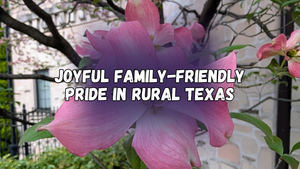
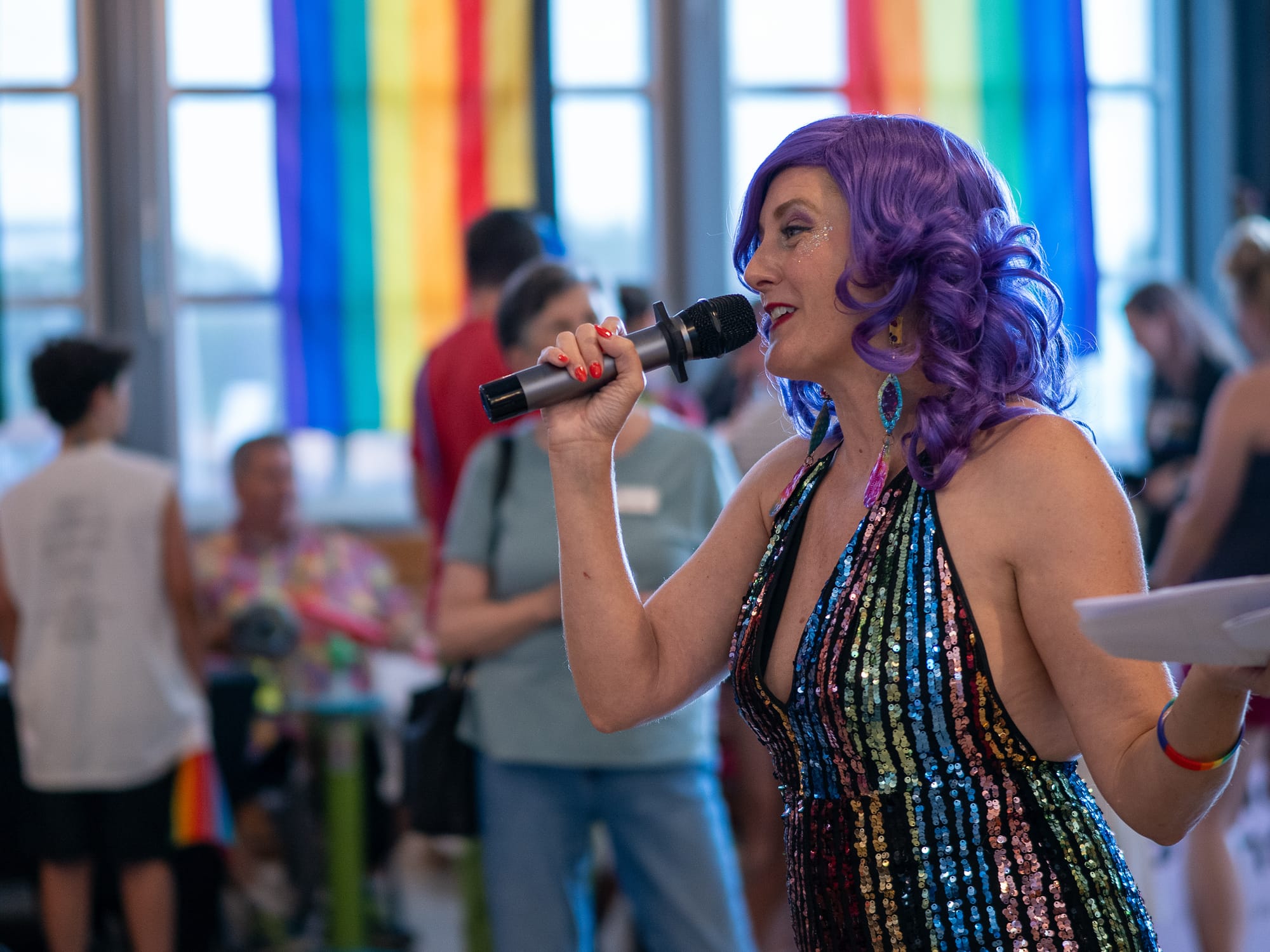
Becky recently emceed a family-friendly Pride event in a small town in rural Texas, and it was lovely to hear about what it means to create that supportive environment.
We also talked about how activism can be joyful, pleasurable, and doesn't need to lead to burnout. This is what we need for a better future! And Becky has ideas to make that happen.
Let's dive in!
(This interview has been lightly edited for clarity.)
Rey: Hi Becky, I’m so excited that you emceed a family-friendly Pride event in rural Texas. Can you set the stage - is this a queer friendly Texas small town, or not LGBTQ+ friendly at all? (I have some experience with small towns in New Jersey where I grew up. When I go back to visit, some towns are flying rainbow flags, which is really nice.) I’m wondering, do you have a sense of what this town is like where you held the Pride event?
Becky: Austin is definitely the queer city in Texas, and so it is a place where a lot of folks will migrate to from other parts of Texas. Once you get outside the borders of Austin, you really can’t be sure as a queer person, especially as a visibly queer person, how you will be received and what sort of interactions you’ll have.
Dripping Springs, TX is a really small town, but it’s not too far away from Austin. The further you get out the more tenuous you are, but truly anywhere outside of the borders of a big city here, you’re just not sure.
So they just started doing Pride three years ago in Dripping Springs. Before that, the loudest, meanest voices made everyone else scared to be out. They made the town feel unsafe even if there weren’t that many people speaking as they did. These few people had an outsized impact on the vibe.
Before Pride of Dripping Springs started doing their Pride celebration, a lot of folks were kind of quiet and not really visible.
This year’s Pride event, which had a couple hundred people, was actually smaller than the first one. I think they had close to a thousand people come out from outlying areas.
The Hill Country is a bunch of scattered little towns, and I think it was shocking to people who were only used to hearing those loud, mean, scary voices to connect with so many other folks who, for maybe the first time, felt safe to show up and be visible and find each other.
Rey: That’s really meaningful, and I think it’s important to notice that it’s just a few people who can be really loud and affect the experience of so many other people.
I wonder if you know where these people were being loud like you said? Were people being harassed out in public, or on the internet, or in the media?
Becky: So my understanding is that Facebook is where a lot of folks in rural Texas towns are connecting with each other. There’s a lot of neighborhood chatter. What I heard a lot about was that Facebook is the main place where things felt mean and scary. I don’t live in Dripping Springs, so I don’t know if there were instances of physical intimidation or not and can’t speak to that.
Rey: That makes sense. But when everyone got together for an in-person event, this celebration seemed to go really well.
At this Pride event, did parents bring their kids? Did people talk to you about what this experience meant to them?
Becky: I felt really lucky to be there because I didn’t organize the event, I was just invited to come and be the emcee and host. It felt very special to be invited to be part of their community.
Because I was very visible in the event, people kept coming up to me and saying, thank you so much, this means so much to us in this community, because we’re not always sure who is safe to be ourselves around.
And so to have this celebration and space to be joyful, it was so meaningful. Folks got emotional. I got emotional.
There were a lot of families who came together. Pride of Dripping Springs had organized a separate event only for grownups earlier in the week, but this one they intentionally wanted to create a space where people of all ages could have a good experience.
They set up activities ranging from balloon animals and face painting to a flash tattoo station, truly, something for all ages. They set up a special area just for teens, with board games, so they had their own little space. I have a preteen daughter, so now I very much get how important it is for that age group to have their own little space.
It was so beautiful! They had drag performers, too, which is a big thing right now in Texas because there’s a drag ban which our state legislature passed. [and was recently upheld by a federal court] It’s less restrictive than people think, but it has had the effect of making folks nervous to have drag at family friendly activities. Inviting drag performers was pretty brave of them in the current context of things here.
But it was so cute seeing these little girls amazed by the drag performers. I was also wearing a purple wig and rainbow sequin dress. The little girls wanted to dance with me with their parents, which was so cute and a lovely experience. We were all dancing together, and it was very sweet, multi-generational, and wholesome.
Rey: What did it mean to you, to be there, experiencing this Pride event yourself?
Becky: I grew up outside of Los Angeles, in an Evangelical, conservative home and community. So I didn’t even realize I was queer until I left home when I was 19. Like, it just wasn’t an option for me growing up.
To have grown up in a home where it was explicitly not allowed to be queer, or the way that folks in my community talked about queer people, it was extremely hurtful.
So, to be in a space where families were not just affirming the existence of queer people in a theoretical way, they were bringing their kids to celebrate with folks all across the LGBTQ+ spectrum, such a difference, right?
It was very healing for my own inner child to be on that dance floor with those little girls dancing to Pink Pony Club - we all love it!
There was a little bit of grief for my own young self for not being able to experience that back then. But, I’m able to work on healing that for myself now as a grown-up. Witnessing these children who are growing up in a world where that is available to them from a young age, was really special.
Rey: That’s beautiful, thank you for sharing. I sometimes feel bittersweet when I see kids today having all these incredible experiences and support from their families and communities. Community support for LGBTQ+ folks wasn’t really a thing when I was growing up either.
It’s really nice as an adult to be able to participate in some of these experiences because it’s never too late to feel that love and support from your community.
Becky: I didn’t realize I was queer until I was 19, and so it was a process of discovery for myself, and I’m still in the process of coming out.
I’m taking my daughters to visit my family back in California. And while we’re there, my dad is going to be preaching at church on Sunday morning, and has said he’d love for us all to come.
I’m grappling with never actually having had a direct conversation with my dad about being queer, like I have with my mom.
Even though I’m now 45 years old, it’s still scary to me to have that conversation, and to be honest with him that I don’t actually want to go to church.
I want to support my dad, because I know it’s important to him that he’s getting up and speaking. But the church is not a place that’s affirming to me. I don’t want to set the example for my children that I’m going to put myself in a place where I’m not welcome, to make someone else happy. It’s still a process, for sure.
Rey: Can you tell us about your activism, and Democrasexy? (Such a cool name!)
Becky: My background is in advertising, where I spent most of my career. But after the 2016 election, I was really upset with myself because I felt like I could have taken more action other than just voting to impact the outcome of that election.
And then, on a larger scale, I realized I had not been taking a lot of action to make the world the place that I want it to be, and I never wanted to have that feeling again.
So, I spent a few years learning as much as I could about state and local political systems in Texas because I figured at the state and local level was where I could have the most impact.
And after a while of learning, I realized that it’s difficult as a beginner to these civic spaces, to figure out how it works and where to begin. And it didn’t always feel welcoming.
I realized there were probably a lot of other folks like me who cared a lot and wanted things to be different, but who felt intimidated and overwhelmed and didn’t know how to begin.
So I became a community organizer and put my advertising background to good use as a communicator. I create content for Instagram, and I also have a newsletter that people can sign up for at democrasexy.com.
I share information about how people can take action and make an impact, but in a way that hopefully feels good to them. My whole philosophy about the work we need to do, especially in a state like Texas, is that the work will outlast us. So we need to set ourselves up in a sustainable way to keep at it for as long as we can, which means it should feel as joyful as possible, and it should connect us with each other.
That’s what I’m really trying to do: create that community and create that joy so we can keep going.
Rey: I love that. Creating that joyful connection is powerful all on its own.
Do you have any advice for trans and queer people who are stressed and anxious right now?
Becky: What you’re doing is so important. [Aww, thank you!] Any sort of resources that folks can connect with, specifically for trans and queer people, I think is so helpful.
In addition to the content that I publish, I also have organized my own events. I collaborated with a queer therapist to do a series called TEX Support, a group for folks who are sad about being queer in Texas.
I encourage people to create spaces, you know, it doesn't need to be formal. Getting together with folks who share your identity and values in a space to decompress and talk about things can be so important.
I think a lot of folks don't realize that not talking about the hard and scary stuff actually makes it worse, and feel bigger. But when you do say the things out loud that are scaring you, like every time we had one of those sessions, people would walk away feeling so much lighter, even though nothing had changed in our circumstances.
Unburdening through talking about it really helped, as well as realizing that we're not alone. So many people are feeling similar to how we feel.
The other thing I've been doing a lot of is learning the stories of the queer ancestors who came before us and were able to accomplish really incredible things under even more challenging circumstances that we find ourselves in. I find learning about these folks to be very hopeful and helpful.
Rey: That's amazing! Do you have anyone in particular who you found inspiring recently?
Becky: Pauli Murray's story is so inspiring to me. I adore Pauli's story and everything about them. I even made a little pilgrimage to the Pauli Murray Center in North Carolina last year.
Rey: I watched a documentary about Pauli Murray and thought Pauli's work was really interesting and amazing.
Becky: One thousand percent. Back then, we didn't even have the language around transness, so I'm not sure that we could know exactly how Pauli would identify. At the Pauli Murray Center, they use all different pronouns interchangeably, because they are also not sure what Pauli would have wanted in this day and age.
Just reading about their experience in trying to grapple with issues of gender without having the language is really inspiring.
Rey: I thought it was really incredible that Pauli was working with a doctor just trying to figure out what was going on with their body. Today, we would probably consider wanting to investigate for hidden testicles a sign that you might be trans, but back then, the options were limited in terms of medical science. So what's left is how you can present yourself in the world socially, with hair and clothes and everything like that. So I thought it was fascinating what Pauli Murray managed to do.
Becky, what brings you hope?
Becky: A lot of things in my own home and working on healing my inner child.
I'm raising two little girls (or at least, so far they identify as girls). They are able to have conversations with me about exploring gender and LGBTQ+ identities that are so healing for me.
To see the freedom they have to grapple with what their identity means - how I grew up is not at all that way - so it feels really hopeful to watch my kids and their friends have a level of freedom I couldn't have imagined at their age.
They know they have a special opportunity because I tell them it wasn't always that way, but in their experience, it feels normal to them, and that's excellent.
Rey: In a lot of non-LGBTQ+ families, it's really normal to talk about gender norms, like girls and boys being attracted to each other. This tends to be very heterosexual in our culture.
It's really cool that you are speaking to your kids similarly, but incorporating the option that some people are LGBTQ+ and that it's healthy and normal, in this age-appropriate but also very freeing way, to know who you are is okay. That's really incredible.
Becky: When you speak to a child in an age-appropriate way about really any topic, it boils down that topic and really clarifies it. Like, how much more simple is some of this stuff, and how complicated we as grown-ups can make it?
Rey: Thanks for supporting your kids and your community in this way. It really means a lot.
This has been so inspiring and touching, and I'm so glad to get to hear about your experience.
Are you working on anything else you'd like to share?
Becky: I'd like to invite people to connect with me on Instagram - Democrasexy is where you can find me.
I am working on a big new project that folks can keep their eyes out for: I'm going to be producing a new video podcast about learning about the folks who came before us. I'm going to be sharing stories of Texas women and queer people who accomplished incredible progress, not just for Texas, but for all of America, to give us a little bit of a different flavor of what a Texan can be, versus what we often associate with Texans.
So, look out for that - it's going to be called The Texan Optimist.
Rey: That sounds amazing! I want to watch even though I'm not from Texas - love it!
Thanks so much, Becky, for sharing your experience and work with us!
Join Amplify Respect to receive future articles inspiring less anxiety and more hope:
What do you think? Let us know in the comments!